




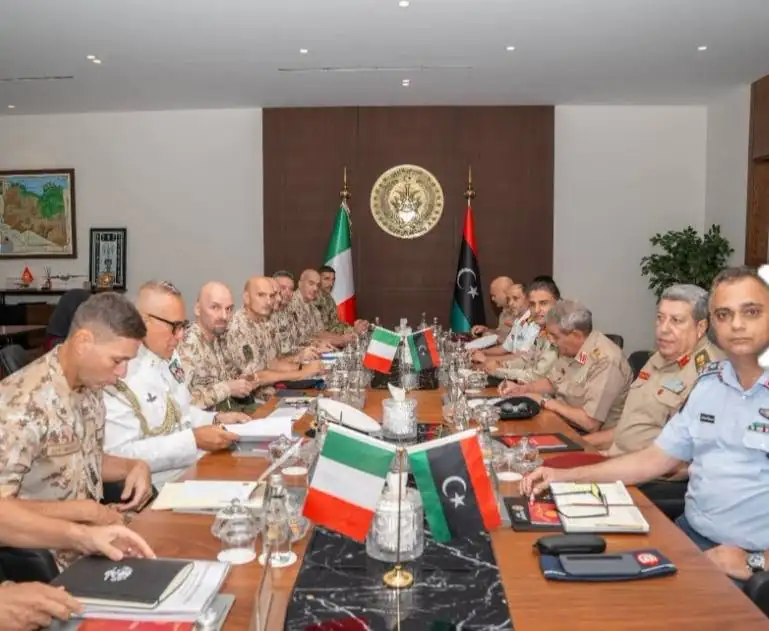
In the complex and changing landscape of international geopolitical balance, the security of Italy and the entire Mediterranean basin cannot disregard a far-sighted and pragmatic vision. In this context, the action carried out with determination by the Ministry of Defense and the General Staff of the Defense deserves the highest appreciation, culminating in the recent and significant bilateral meeting between the Chief of Staff, General Luciano Portolano, and his counterpart in Tripoli, General Salah Al-Namroush.
The line traced by Italian military leaders confirms that Libya is not merely a geographically close country, but a crucial pillar for protecting our Nation's vital interests. The choice to focus on structured dialogue and strengthening military cooperation represents the best way not only to support Libya's transition and pacification, but also to secure our national security on delicate fronts such as counterterrorism, combating illicit trafficking and managing irregular migration.
360-degree cooperation: from cybersecurity to energy
What is convincing in the Defense's approach is the concreteness of its objectives. The agreement aimed at increasing the efficiency and capabilities of the Libyan Armed Forces – extending to cutting-edge sectors such as cybersecurity, Special Forces training and training of Libyan attendees in Italian military academies – demonstrates clear awareness: a country's stability inevitably passes through the professionalization and authority of its security institutions.
At the same time, the strategic importance of protecting energy infrastructure cannot be underestimated. The continuity of gas and oil supplies from Libya is an absolute priority for Italian energy security. In this sense, the hope to extend cooperation to the technical-industrial sector with major Italian companies opens prospects for mutual economic growth and collaboration, sealing a solid and lasting partnership.
Continuity of commitment: the tangible sign of institutions in the field
Italy's strategic attention toward the Libyan theater is not exhausted at diplomatic tables, but enjoys tangible operational and institutional continuity. This was confirmed by the recent visit to Libyan soil by the Defense Commission – welcomed by the Commander of MIASIT, Brigadier General Maurizio Settesoldi – a moment that reaffirmed how Parliament and political forces closely and determinedly follow the mission's activities.
The success of this strategy is further reflected in the words of deep gratitude expressed by the Libyan Under-Secretary of State for Defense, General Abdulsalam Al Zoubi, testifying to how Italy's role is perceived in Tripoli as fundamental, balanced and loyal.
Special praise goes to the personnel who work daily on the ground: from the activities of the Bilateral Assistance and Support Mission in Libya (MIASIT) to the commitment of the Carabinieri, the Financial Police, the military staff of the Italian Embassy led by Ambassador Gianluca Alberini, to the crews engaged in ports such as that of Nave Pantelleria in Abu Sitta. Men and women in uniform who, under the guidance of Defense Minister Guido Crosetto and the General Staff, represent the excellence and continuity of our commitment.
Italian Defense demonstrates, once again, its ability to combine international projection with the uncompromising defense of national interests. In a geopolitical scenario marked by profound instability, it is indeed vital to stem and counter Russian influence's advance in the region, securing Europe's southern flank from dangerous external interference. Investing in Libya's stability means investing in the future, peace and security of Italy and all of Europe. A course charted with courage and competence, which deserves the country's support and convinced consideration.




Comments
No comments yet. Be the first!