


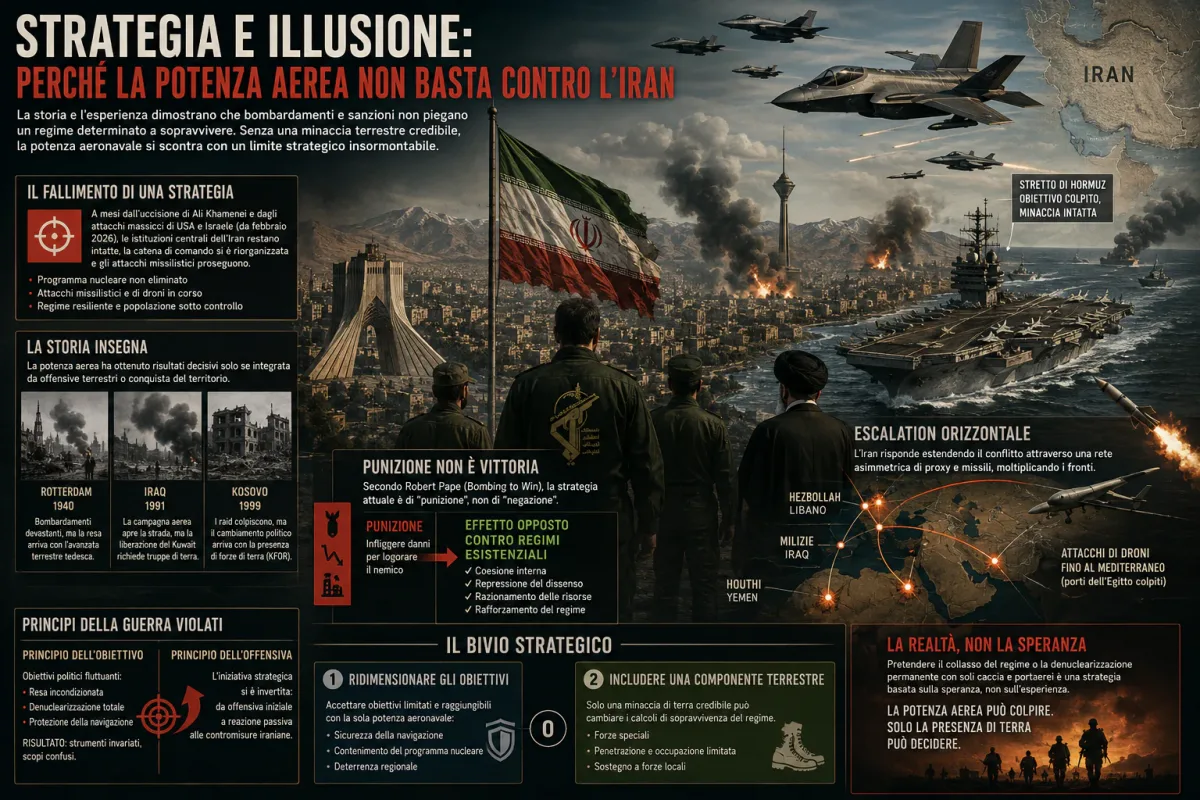

In the essay “The Limits of Air and Naval Power Against Iran” (published on August 1, 2026), the author Stephen D. Cook — retired lieutenant colonel of the U.S. Army Special Forces and decorated veteran — analyzes the consequences of the air campaign conducted between the United States and Israel starting in February 2026. The intervention, culminating in the killing of the Supreme Leader Ali Khamenei, was accompanied by maximalist intentions aimed at imposing an “unconditional surrender” to definitively block the Iranian nuclear program. However, months later and despite continuous bombings targeting the Strait of Hormuz, the central institutions of the Islamic Republic remain intact, the chain of command has reorganized, and the missile attacks continue.
This scenario highlights a recurring historical limitation. The exclusive use of air and naval power, in the absence of a credible land threat, regularly fails when confronting governments that perceive the stakes in existential terms. Without troops on the ground capable of directly threatening the regime's survival, the projection of force from a distance clashes with a rigid strategic reality: punitive bombings are not enough to bend a state determined to resist indefinitely.
The Mirage of Air Decisiveness and the Trap of Punishment
For over a century, air power theorists have posited that strategic bombings can break an opponent's political will without resorting to infantry. Historical analysis, however, tells a very different story. Iconic historical cases — from the bombing of Rotterdam in 1940 to the air campaigns over Kosovo in 1999 or Iraq in 1991 — demonstrate that air pressure achieved decisive results only when integrated with coordinated ground offensives or local forces engaged in the physical conquest of territory.
In his seminal study Bombing to Win, Robert Pape distinguishes between strategies of “punishment” and “denial”. The strategy currently applied against Iran falls entirely into the former category: inflicting infrastructural and economic damage to wear down the enemy. However, against an autocratic regime facing an existential threat, punishment has the opposite effect. Instead of triggering a popular rebellion, external aggression sparks a dynamic of internal cohesion. The Islamic Revolutionary Guard Corps exploits the state of emergency to suppress dissent, ration resources, and tighten its grip on the civilian population, turning the crisis into a pretext to fortify power.
Horizontal Escalation and the Crisis of Military Objectives
The absence of a viable ground option not only ensures the resilience of the Iranian regime in Tehran but dangerously expands the conflict on a regional level. Iran, aware of its inferiority in conventional maneuver warfare, has relied on an asymmetric network of proxies and a missile strategy capable of extending the theater of war well beyond the original borders, as demonstrated by recent drone attacks that have grazed Egypt's Mediterranean ports. An indefinite stalemate campaign offers Tehran the time and pretext to wear down Western alliances and increase global economic pressure.
To this is added a systematic violation of the fundamental principles of war. The Principle of the Objective has been repeatedly compromised by fluctuating political goals: shifting from demanding unconditional surrender to protecting commercial navigation, leaving the military instrument employed unchanged. At the same time, the Principle of the Offensive has vanished as the strategic initiative shifted from initial bombings to passive reaction in the face of Iranian countermeasures.
Political leaders now find themselves at an unavoidable crossroads. Continuing to demand the total collapse of the regime or permanent denuclearization relying solely on fighters and aircraft carriers constitutes a strategy based on hope rather than empirical experience. The real options remain two: scale down political objectives to circumscribed and achievable goals through air-naval power alone, or recognize that the force employed must necessarily include a credible ground component to alter the regime's survival calculations.




Comments
No comments yet. Be the first!