




The Bridge over the Strait of Messina, often at the center of national political debate, has forcefully returned to prominence as an infrastructure not only for roads but also strategic-military. The Meloni government has officially defined the project as “imperatively prevailing for public interest,” emphasizing its importance in both civil and defense contexts.
It is not just a great engineering work: the Bridge will be an integral part of an infrastructure network that will connect Sicily and Calabria at the point where the two shores are closest, becoming a crucial hub for the mobility of Italian, European, and NATO armed forces.
In the document sent to the European Commission, the Bridge is indeed included in the context of the Trans-European Transport Network (TEN-T), the network that connects the main logistical corridors of the European Union. This network is not only for economic and civil purposes: it is also designed to facilitate “military mobility”, allowing the rapid deployment of troops and equipment in case of crisis, aggression, or natural disaster. In this sense, the Bridge over the Strait is not just a national infrastructure: it is a European strategic asset.
Just as the Turin-Lyon is part of the strategic east-west railway corridor, the Bridge will serve a north-south corridor connecting Sicily – with its NATO bases like Sigonella – to the heart of Europe. In a rapidly evolving geopolitical scenario, where the Atlantic Alliance has increased its focus on the southern flank, the Bridge represents a concrete response to the needs of European collective defense.
According to estimates, the connection will be able to handle up to 6,000 vehicles per hour and 200 trains per day, remaining operational 24 hours a day throughout the year. This will allow the rapid movement of troops, land vehicles, and strategic materials in case of emergency, giving Italy a key role in the security of the Mediterranean.
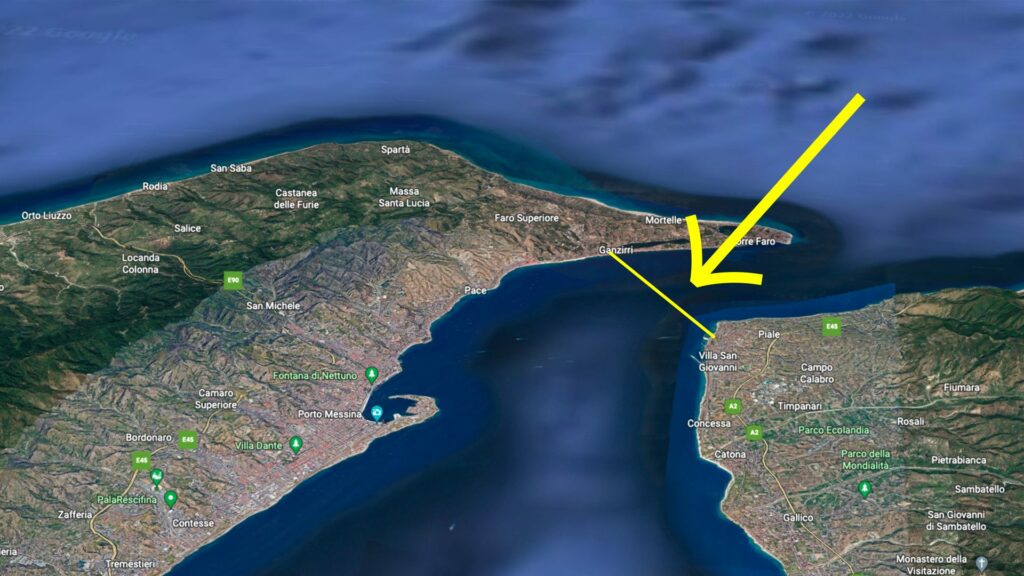
A Project Designed to Last Two Centuries
From a technical point of view, the Bridge is designed to tackle some of the most complex environmental and engineering challenges in Europe. The total length between the expansion joints will be 3,666 meters, with a central suspended span of 3,300 meters – the longest in the world for bridges of the same category. This engineering achievement is made possible by cutting-edge construction solutions, such as the “Messina style” deck, with a multi-box girder profile that ensures not only structural robustness but also aerodynamics.
The bridge is designed to withstand winds up to 216 km/h, well beyond the strongest gusts ever recorded in the area (140 km/h in over twenty years of monitoring). Wind tunnel studies have also ensured that even in the presence of strong winds, traffic can proceed safely, maintaining high levels of comfort for users.
On the seismic front, the structure will be able to withstand an earthquake with a magnitude of Mw=7.1, similar to the earthquake that devastated Messina in 1908. The two towers that will support the deck will have a height of 399 meters and a weight of 55,000 tons each. Made of prefabricated octagonal steel segments, they will be assembled on-site using an independent climbing system for each leg, resting on circular reinforced concrete plinths with a diameter of 55 meters (Sicily tower) and 48 meters (Calabria tower).
The suspension system includes four main high-strength steel cables, each composed of 44,323 wires and over 5,300 meters long, with a total weight of about 170,000 tons. The hangers, connected every 30 meters to the main cables, will support the deck on both sides, ensuring dynamic stability even under extreme loads.

A Bridge Between Strategic Integration and European Sovereignty
Besides representing a technological challenge, the Bridge over the Strait has significant symbolic and geopolitical value. It unites two historically separated territories, overcoming natural limits, infrastructural delays, and perhaps even cultural barriers. The direct connection between Sicily and Calabria strengthens the economic and social integration of the South, reducing transport times and costs for goods and people.
But the real novelty of 2025 is the strategic positioning of the project within the European common defense policy. In an era marked by new international tensions, Europe is equipping itself to respond quickly and effectively to hybrid threats, regional conflicts, and natural disasters. The Bridge over the Strait can serve as a mobility hub for emergency missions, NATO interventions, civil protection operations, and military logistics, becoming a cornerstone of the European Union's “Military Mobility”.
The anchorage blocks, which support the main cables, are designed to minimize visual impact (only 17% of the volume will be above ground), while ensuring exceptional stability, thanks to a system of post-tensioned tendons and steel plates. The railway equipment has also been designed with embedded rail technology, which allows for a reduction in vibrations and noise emissions, as well as savings in terms of overall weight.
With an estimated useful life of 200 years, the project aims to become not only a symbol of progress but also an essential tool for the resilience and security of the European Union. No longer just a dream of Italian engineering, but a pillar of continental strategic sovereignty.




Comments
No comments yet. Be the first!