




Project Convergence is the flagship initiative of the United States Army for the development of integrated and digitized military capabilities, aimed at unifying sensors, effectors, and commands through a single real-time operational network. Born in 2020, the project aims to radically transform land warfare by leveraging artificial intelligence, advanced communication networks, and joint collaboration. Within this program, the term Capstone refers to a large-scale final exercise in which all the capabilities tested in the previous months are put to the test.
The project “Project Convergence - Capstone 5” recently staged a high-tech war scenario involving all U.S. armed forces – Army, Navy, Air Force, Marine Corps, and Space Force – in a joint operation to "reclaim" the National Training Center at Fort Irwin, California, from a simulated enemy force. The exercise, held between March and April 2025, marked a decisive moment in the development of multi-domain operations, oriented towards a fully interconnected warfare model.

The operation saw an unprecedented integration of forces and technologies. Naval drones attacked enemy ships off the coast of San Diego, while manned and unmanned aircraft struck enemy air defenses. U.S. satellites disrupted enemy communications with electromagnetic attacks, while long-range missiles prepared the ground for infiltration by helicopters and ground vehicles, under the cover of attack helicopters. Once the offensive was over, the forces had to quickly switch to defending the newly conquered territory.
According to Lieutenant General David Hodne, deputy commander of the Army Futures Command, this iteration of Project Convergence represented a decisive step forward. “For the first time, we integrated everything into a single coherent scenario, deploying military capabilities from the Fort Irwin area to Pendleton, along the entire California coast,” he stated. The goal was to test full interoperability between U.S. and allied land, air, naval, and space forces in a realistic war scenario.

The Network Challenge: Unifying Data, Commands, and Decisions
One of the main obstacles to future warfare is not the enemy, but the interconnection of systems. As Major General Patrick Ellis, head of the Command and Control Cross-Functional Team, explained, “we collect a lot of data, but often it's not in the right place or in the right format.” The main problem is that the various “boxes” – the hardware and software systems – communicate with each other inefficiently, requiring continuous manual steps to transform and re-enter the data.
Capstone 5 served as a testing ground for a new type of software, developed in collaboration with the defense industry, aimed at connecting all sensors, commands, and decision centers into a single visual interface accessible in real-time from every command center. In practice, the exercise sought to create a sort of “distributed digital brain,” where every command can see the same updated picture of the battlefield and make coherent decisions.
This approach was further tested in a second joint mission in the Indo-Pacific, involving bases in Hawaii, Japan, the Philippines, French Polynesia, and Australia. The data collected was shared not only among U.S. forces but also with British, French, and Japanese partners, demonstrating the system's potential for international interoperability.
Lieutenant General J.B. Vowell, deputy commander of the U.S. Army Pacific, commented: “PC-C5 confirmed to us that we are on the right track. Now we just need to accelerate.” The speed of development and adaptation is, in fact, the real critical factor in an era where informational superiority is worth more than the number of men or means.
Integrated Fire and Robotics: The Next Frontiers of Warfare
Project Convergence highlighted the growing need to combine offensive and defensive capabilities in unified systems. Currently, the army has distinct means for the two functions: offensive systems like HIMARS to strike strategic targets and defensive systems like Patriot missiles to shoot down aerial threats. But in a dynamic scenario, where a unit must conquer, hold, and defend an area, an integrated system is necessary.
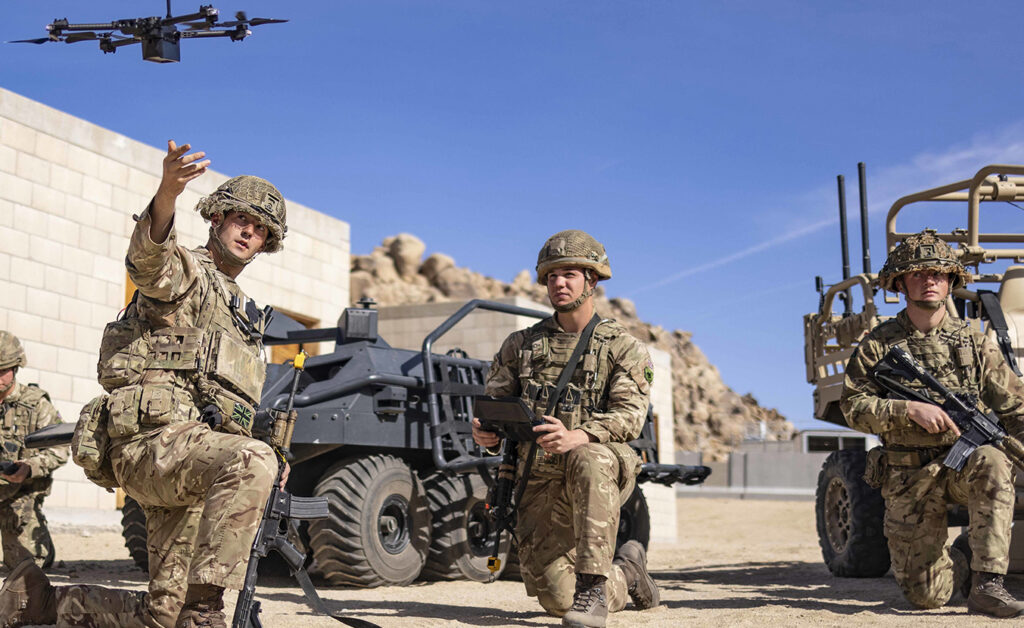
“It won't happen this year,” Vowell admitted, “but we will continue to experiment, test, and innovate. We'll get there.” In this context, robotic vehicles play an increasingly central role. At Fort Irwin, ground combat robots led the assault once enemy defenses were down. Although the U.S. Army does not yet have these vehicles on a large scale, they are now a growing priority in technological development.
Lieutenant General Hodne emphasized: “Every time we find new uses for robots. It's not a change of course, but an expansion of possibilities.” The next step will be to identify which robots offer the best operational and financial return for the army. To this end, the Transformation-in-Contact units will work closely with the defense industry to prototype and test new solutions.
The appointment is already set: Project Convergence - Capstone 6 will take place in August 2025. It will be an opportunity to see if the Army has managed to bridge the gap between digital aspirations and operational capabilities in the field.




Comments
No comments yet. Be the first!