


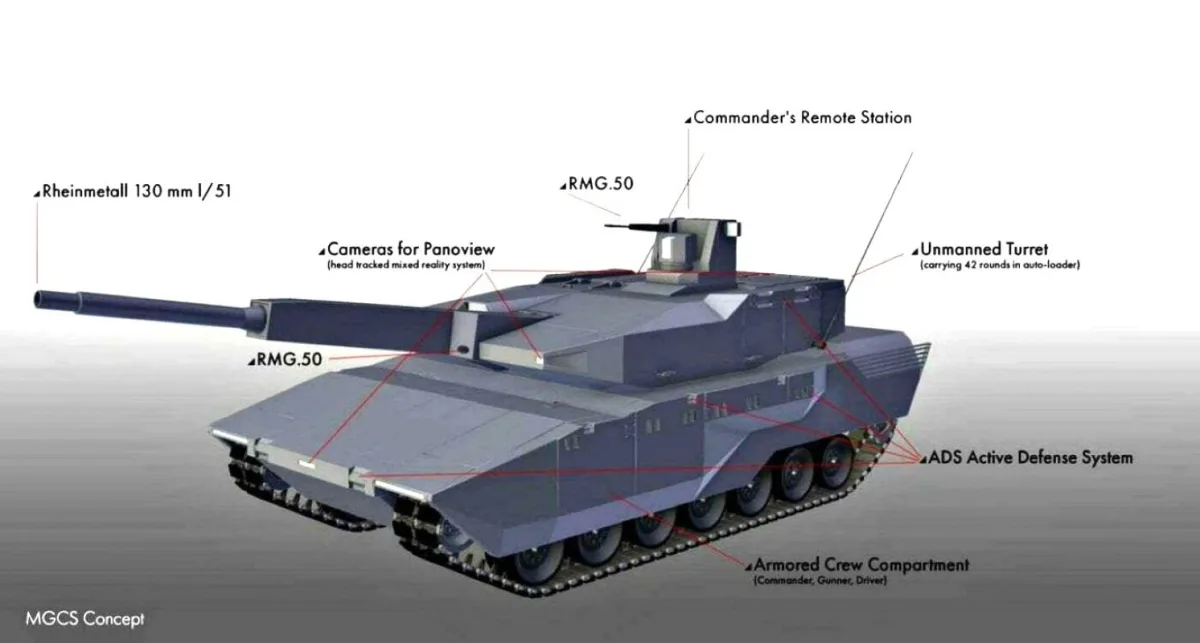

According to Zone Militaire (Opex360), citing a report, the French Army (Armée de Terre) is close to a decision on a “transition tank”: a bridging solution necessary because, even after the upgrade to the Leclerc XLR standard, the current tank may not cover the entire period separating Paris from the arrival of the MGCS (Main Ground Combat System), the next-generation land system developed with Germany.
The Issue: Keeping the Leclerc in Service Until MGCS
The issue is not only “technical” but also one of timing and actual fleet availability. On one hand, France has initiated the modernization of the Leclerc XLR as part of the SCORPION transformation; on the other, the horizon for MGCS keeps shifting, while platform wear and obsolescence erode operational readiness.
A recent document from the French Senate frames the problem explicitly: the Leclerc could be replaced by the MGCS “by 2045” and, “in the meantime,” it is necessary to avoid capability gaps by maintaining the vehicle's availability and operability. The same text highlights obsolescences particularly affecting engine components (turbomachinery) and optronic sensors, addressed through fleet renewal and “perpetuation” interventions.

What the Leclerc XLR Brings (and What It Doesn't Solve)
The XLR upgrade is designed to integrate the tank into collaborative combat (SCORPION), with more modern connectivity and data management. In summary, the update introduces elements such as the SICS information system and the CONTACT radio, a remote-controlled turret, and improvements in protection and survivability (including, according to reconstructions, the inclusion of the BARAGE jammer against threats like IEDs/rockets). However, the adoption of an Active Protection System (APS) is not “default” in the package, and especially the engine remains a sensitive point.
Numerically, the trajectory indicated in various sources is clear: the goal is to reach 200 modernized Leclercs, with an intermediate milestone of 160 by 2030 and the remaining 40 by 2035.
An analysis relayed by IFRI (which summarizes a report dedicated to the future of the armored component) highlights that, although some official numbers are no longer published, the estimated availability of the Leclerc would remain very low, with assessments in the order of 25–35% in 2025. In the same context, the XLR modernization is described as insufficient to remove some of the most critical obsolescences, including the engine; re-engining would be possible but costly: about 1.5 billion euros according to a cited estimate.
It is in this context that the hypothesis of a transition tank becomes central: not just a simple upgrade, but a choice to cover the 2030–2045 window (or the long wait) without losing critical mass and operational credibility in heavy maneuvering.

MGCS: Project Progressing, But Still a Long Horizon
On the MGCS front, recent months have seen signs of industrial and political progress. The partners KNDS, Rheinmetall, and Thales have formalized the corporate structure dedicated to the program: a project company with 25% shares each, headquartered in Cologne, and a national work distribution of 50/50 between France and Germany.
Official communications frame MGCS as a multi-platform system intended to replace Leclerc and Leopard 2, with a temporal goal often indicated as “by 2040”.
However, French parliamentary documents related to the budget cycle also describe a detailed study roadmap: conclusion of the architecture, restructuring into eight “pillars”, initiation of studies (phase 1A), and a target of first deliveries around 2040, while acknowledging delays compared to previous forecasts.
In parallel, both general and specialized press have highlighted how delays and industrial competition (new projects, upgrades, and alternative joint ventures) increase pressure on the Franco-German program.

What Options for the French “Transition Tank”
The debate, at least in general terms, revolves around three paths:
- “Off-the-shelf” Purchase
IFRI describes the idea of purchasing Leopard 2 as the most immediate option on paper, but with two obstacles: delivery times (already loaded chains, difficult to see deliveries before 2030) and potentially limited industrial return, with the risk of eroding the national tank base. - Alternative Foreign Solution (e.g., South Korean K2)
IFRI also notes that a path could involve the K2, even hypothesizing faster initial deliveries (under certain conditions) and evolving partnerships. - National/“Sovereign” Transitional Development
A hypothesis that preserves skills and the supply chain but requires political will and investments. In IFRI's reconstruction, a possible “bridge tank” should remain in a manageable weight range (approximately 45–55 tons), integrate active protection, counter-drone capabilities, and a more modern set of sensors/effectors, also with the use of organic drones.
Why the “Imminent” Decision Matters Beyond France
If Paris is indeed about to decide, as indicated by Zone Militaire's report, the choice will have effects on three levels:
- Operational: avoiding a “capability gap” in heavy armored maneuvering just as Europe revisits Ukrainian lessons (drones, loitering munitions, widespread anti-tank threats).
- Industrial: whether to preserve a national value chain (and thus autonomy, export, maintenance, technological sovereignty).
- European: the coherence between the national “bridge” and MGCS will condition interoperability, future standards, and the credibility of major cooperative programs.
In summary, the hypothesis of the transition tank arises from a simple reality: between Leclerc XLR and MGCS, there is a time window long enough to become a strategic vulnerability. It is there that the “real” urgency of the decision plays out.




Comments
No comments yet. Be the first!