




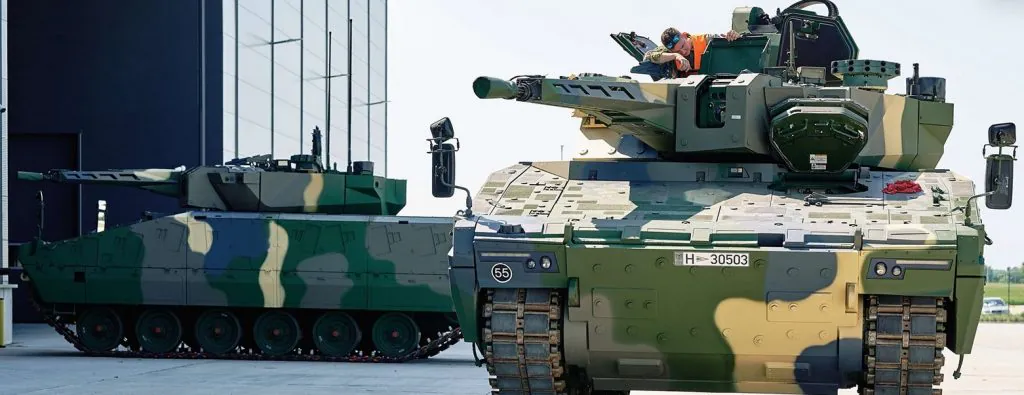
Global strategic confidence in Rheinmetall's land technology finds a twofold, striking transatlantic confirmation. While in Rome the 50-50 joint venture Leonardo Rheinmetall Military Vehicles (LRMV) proceeds at full pace in supplying armored programs for the Italian Army, the United States takes the same step: American Rheinmetall has indeed delivered the first of eight prototypes of the Lynx XM30 vehicle to the US Army, laying the groundwork for replacing the historic and ubiquitous M2 Bradley.
The move confirms how the Lynx platform — a cornerstone choice also for Italy's industrial vision for heavy infantry renewal — is now the Western reference point for next-generation armored vehicles.
Key Facts of the XM30 Program in the United States
- Delivery and testing: American Rheinmetall has delivered the first of eight prototypes to the US Army, initiating government development and performance testing under the EMD (Engineering and Manufacturing Development) contract worth approximately 764 million dollars.
- TiC 2.0 Initiative: The prototypes support the Army's Transformation in Contact 2.0 initiative, enabling rapid prototyping, soldier training, and real-scale operational simulations in parallel with technical testing.
- Multi-state industrial supply chain: Production leverages a highly integrated USA logistics and industrial chain, with turret manufacturing in Plymouth (Michigan), hull and chassis assembly in Slidell (Louisiana), and final inspection jointly with DCMA.
- Advanced technology: The Lynx XM30 integrates an open modular architecture, a cutting-edge hybrid-electric propulsion system, and is designed to dominate scenarios characterized by drones and electronic warfare.
- Excellence industrial team: American Rheinmetall leads a premier industrial coalition that includes Textron Systems, Raytheon, L3Harris Technologies, Allison Transmission, and Anduril Industries.
A Shared Industrial Vision
The parallelism between Washington's and Rome's choices highlights an unprecedented doctrinal and industrial convergence. The strategic intuition that led Italy to bet on a European industrial hub centered on bilateral cooperation finds a mirror reflection in the choice of the US administration and military leadership.
Both for the Italian Army — engaged in renewing the combat line — and for the US armed forces, the answer to the challenges of modern warfare passes through advanced digitalization, hybrid propulsion and heavy modularity. Rheinmetall thus confirms itself as the industrial architect of the new armored power of the Atlantic Alliance, with the Italy-United States axis united in the sign of advanced technological modernization.




Comments
No comments yet. Be the first!