


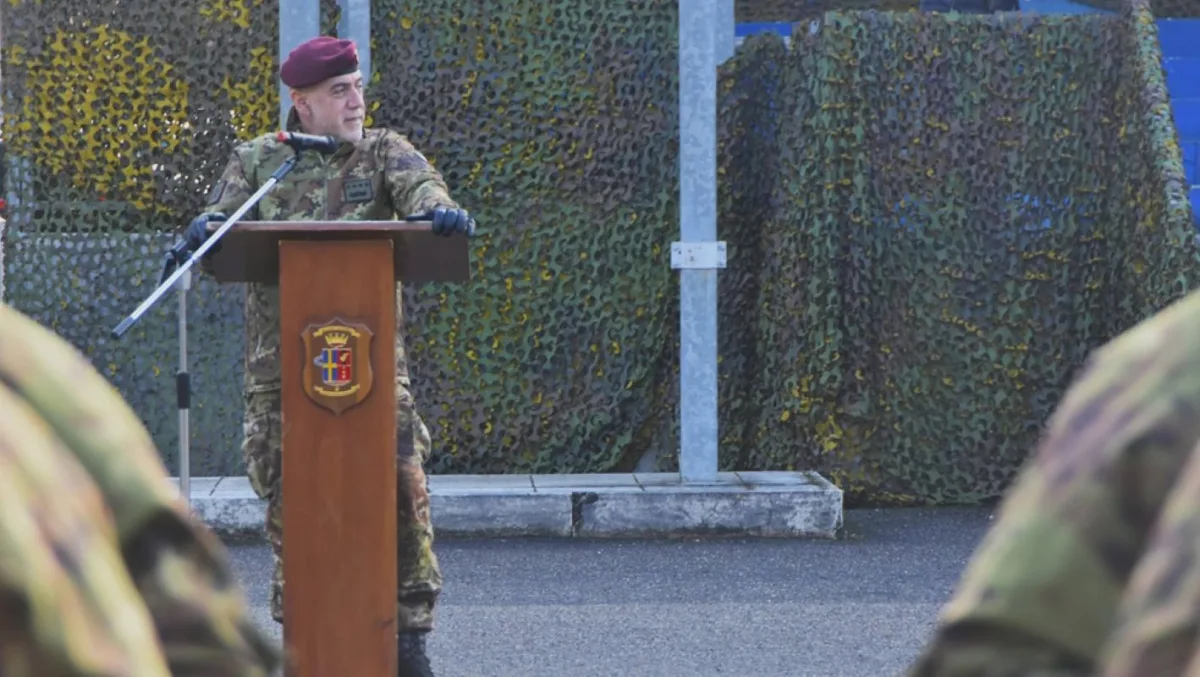

On February 4, 2026, the Chief of Staff of the Army, General of the Army Corps Carmine Masiello, initiated an institutional visit divided into two symbolic stages of the military training path: Viterbo and Verona.
At the Army Non-Commissioned Officers School, the Army's leadership met with the attendees of the 13th Course for Corps Non-Commissioned Officers, a key figure in unit life, a daily point of reference for personnel and a crucial link between command and operational base.
In his welcoming address, General of the Army Corps Masiello emphasized how the role of the Corps Non-Commissioned Officer today assumes an even more strategic value, in a historical phase marked by organizational, technological, and doctrinal transformations. With direct words, he highlighted the importance of personnel knowledge, listening at every command level, conscious discipline, and pride of belonging, indicating these elements as the true lifeblood of the units.
Particular emphasis was placed on change, to be interpreted as an opportunity and not as an imposition, and on overcoming the culture of punishing errors, in favor of a model based on continuous learning. Training, he reiterated, remains the true raison d'être of the soldier. Future Corps Non-Commissioned Officers were asked to be the engine of an Army based on meritocracy, reminding them that consistency represents the concrete measure by which each will interpret their role.
Verona, the Welcome to Initial Term Volunteers
After the Lazio stage, General of the Army Corps Masiello went to Verona, at the 85th Volunteer Training Regiment “Verona”, where he met the Initial Term Volunteers of the 3rd block 2025, incorporated last January 13.
The meeting represented the first official greeting to the young soldiers at the beginning of their twelve-week training path. Addressing the VFI, the Chief of Staff recognized the value of their choice in a complex international context, defining it as courageous and full of responsibility.

He recalled the importance of sacrifice and conscious adherence to values and rules, emphasizing how the Army becomes, from that moment, a new family ready to support every difficulty. In his speech, he also highlighted that the strength of the Armed Force arises from the integration between technology at the service of the soldier, physical, technical, and mental training, and a value system that unites discipline, honor, and love for the Homeland, synthesized by the Tricolor.
A significant passage was dedicated to the role of instructors and the cohesion among comrades, indicated as decisive resources in the most challenging moments of the military journey. No shortcuts, he warned: only those who fully adhere to these principles can be worthy of the uniform.
A Unified Vision for the Future of the Armed Force
From the classrooms of the Non-Commissioned Officers School to the squares of the 85th RAV, a unified vision of the Italian Army emerges, based on the centrality of the person and the quality of training. The direct confrontation with the Corps Non-Commissioned Officers and with the young Volunteers testifies to a present leadership, which chooses dialogue as a guiding tool and example as an educational method.

The Corps Non-Commissioned Officers, custodians of operational experience and daily points of reference in the units, and the Initial Term Volunteers, called to face the first challenges of military life, embody different but complementary responsibilities within the same professional community. On one side, guidance, continuity of values, and the ability to accompany personnel; on the other, the enthusiasm and drive of the new generations. The professionalism of the Non-Commissioned Officers, combined with the commitment of the young soldiers, represents a decisive factor for operational readiness, while meritocracy, listening, conscious discipline, and continuous training become structural elements of the Armed Force's growth.
The message accompanying this visit is clear: the future of the Army depends on the professional and human growth of its men and women. Investing in values means strengthening the ability to face contemporary security challenges and consolidating a strong, coherent identity oriented towards serving the Country.
It is in this synthesis between tradition and innovation that a modern Army takes shape, capable of looking forward without losing the profound sense of its mission.





Comments
No comments yet. Be the first!